SCOPE
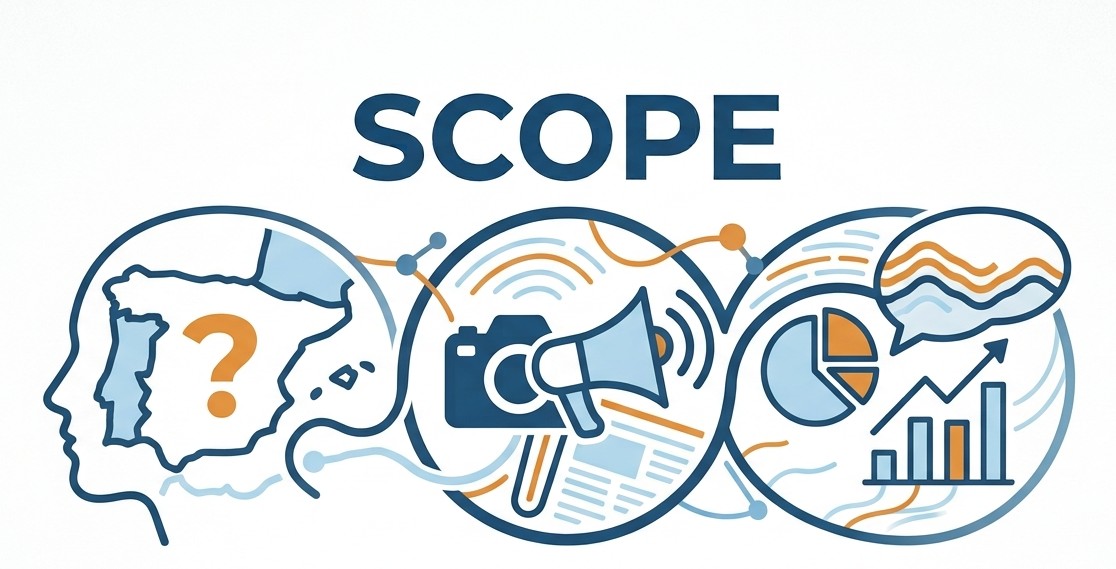
Social Construction of Protest and its Effects: Media depictions and Public Attitudes towards Protest in Spain in comparative perspective (SCOPE)
SCOPE
Social Construction of Protest and its Effects: Media depictions and Public Attitudes towards Protest in Spain in comparative perspective
Principal Investigator: Camilo Cristancho (Universitat de Barcelona) Funding: 2025 Call for “Knowledge Generation Projects” (Type B), Spain Duration: 4 years
About the project
Protest is a core democratic practice through which citizens express dissent and seek political change, yet how societies see protest as legitimate depends heavily on how it is portrayed and understood. SCOPE studies how the media construct the public meaning of protest, and how these portrayals shape public attitudes toward protesters, their demands, and their repertoires of action.
The project combines computational text analysis of over a century of press coverage, existing cross-national survey data, and original survey experiments, across Spain, Portugal, Italy, and Greece.
Work packages
- WP1 — Description of media depictions. A longitudinal, computationally coded dataset of protest coverage in Spanish media (1900–2025) and English-language news wires covering Spain, Portugal, Italy, and Greece (2000–2025).
- WP2 — Media depictions vs. public attitudes. Relating media portrayals to public opinion using the LIVEWHAT and EURYKA cross-national surveys.
- WP3 — Causal inference. Survey experiments in Spain testing the psychological and emotional mechanisms behind support for, or rejection of, protest.
- WP4 — Comparative causal inference. Replication of the experimental design in Portugal, Italy, and Greece to test external validity.
Why it matters
Media coverage does not only reflect public attitudes toward protest — it helps set the norms by which dissent is judged legitimate or not. Understanding these dynamics is central to debates on democratic resilience, polarization, and the right to peaceful assembly across Southern Europe.
Team
| Name | Role / Affiliation |
|---|---|
| Camilo Cristancho | Principal Investigator — Universitat de Barcelona |
| Eduardo Romanos | Researcher — Universidad Complutense de Madrid |
| Aitor Díaz Anabitarte | Researcher — Universitat de Barcelona |
| Teresa Gil-López | Postdoctoral Researcher — Universidad Complutense de Madrid |
| Ruud Wouters | Researcher — Tilburg University |
| Clara Juárez | Researcher — Universitat de Barcelona |
| Martín Portos | Researcher — Scuola Normale Superiore, Florence |
| Thiago Carvalho | Researcher — ISCTE-IUL, Lisbon |
| Alexandros Vlazakis | Researcher — Aristotle University of Thessaloniki |
| Daniel López Roche | PhD Candidate — Universidad Complutense de Madrid |
| Carlos Villalobos | PhD Candidate — Universitat de Barcelona |
| Martín Vergara | PhD Candidate — Universitat de Barcelona |
Related publications
Selected published work by team members on media coverage of protest and public attitudes toward protest.
- Cristancho, C. (2026). Measuring the Protest Paradigm: LLM coding and machine learning approaches to Selection and Framing. Forthcoming.
- Cristancho, C. (2026). A Large-Scale Comparative Perspective of Media Representations of Protest in 21st Century Latin America. Forthcoming.
- Cristancho, C., & Wouters, R. (2022). Protesters at the news gates: An experimental study of journalists’ news judgment of protest events. Communications, 47(2), 262–285.
- Cristancho, C., Uba, K., & Zamponi, L. (2019). Discarding protests? Relating crisis experience to approval of protests among activists and bystanders. Acta Politica, 54(3), 430–457.
- Gil-López, T. (2021). Mainstream protest reporting in the contemporary media environment: Exploring (in)stability and adherence to protest paradigm from 1998 to 2017. Journalism & Mass Communication Quarterly, 98(3), 692–724.
- Gil-López, T., Ahmed, S., & Taylor, L. D. (2025). Testing the Attenuation of Protest Paradigm News Coverage Effects in the Presence of Prior Favorable Attitudes Toward a Cause. International Journal of Public Opinion Research, 37(1), edaf005.
- Romanos, E., & Sádaba, I. (2022). The evolution of contention in Spain (2000-2017): An analysis of protest cycles. Revista Española de Investigaciones Sociológicas, 177, 89-110.
- Romanos, E., López-Roche, D. (2024a). “¿A quién van dirigidas las distintas formas de protesta? Un análisis de la evolución de los objetivos y repertorios de los movimientos sociales en la España del siglo XXI”, Revista Española de Sociología, 33(2), a223.
- Romanos, E., López-Roche, D. (2024b). Herramienta Integrada Digital de Extracción y Análisis de Información Social en Acontecimientos Históricos de Incertidumbre y Riesgo’ (HIDEAIS-AHIR). Entidad financiadora: Centro de Investigaciones Sociológicas, Ayudas a la Investigación.
- Romanos, E. (2020). “Social Movements”, en Diego Muro e Ignacio Lago (eds), The Oxford Handbook of Spanish Politics, Oxford: Oxford University Press.
- Romanos, E., Dolenec, D., Sádaba Rodríguez, I., López-Roche, D., Balković, A., Širinić, D. y Kralj, K. (2025), DISDEM-ECOPOL Spain Protest Dataset, 2000-2020, Harvard Dataverse, V1. DOI: https://doi.org/10.7910/DVN/IK38SW.
- Vlazakis, A. (2024). How Negative Media Framing of Anti-Status Quo Protests Acts as a Social Control Mechanism: A Socio-Psychological Perspective on Protest Paradigm Framework. Protest, 4(2), 207–230.
- Vlazakis, A., & Baka, A. (2023). Uncovering Protest Paradigm Effect Processes: Representations and Perceptions of Media Protest Coverage Among Greek Youth. International Journal of Communication, 17, 20.
- Wouters, R. (2015). Patterns in Advocacy Group Portrayal: Comparing Attributes of Protest and Non-Protest News Items Across Advocacy Groups. Journalism & Mass Communication Quarterly, 92(4), 898–914.
- Wouters, R. (2015). Reporting Demonstrations: On Episodic and Thematic Coverage of Protest Events in Belgian Television News. Political Communication, 32(3), 475–496.
Working papers and pre-registrations in progress will be added as they are published.
Contact
[camilo.cristancho@ub.edu] [X / Bluesky — coming soon] Datasets and materials (in progress): CERCA / Dataverse · Zenodo · OSF
This is the project’s early-stage dissemination page. Content will be updated as the project develops.